
Key Takeaways: Journey to Performance with Realtor.com’s Jordan Blakley
Your traffic numbers look great on an analytics dashboard. But they’re not converting new customers. Sound familiar?
That challenge sat at the center of the first installment of Knotch’s new Journey to Performance series, in which Knotch SVP and Head of Strategy David Brown sits down with leading marketers to explore how they’ve transformed content from a cost center into a growth driver. For the inaugural conversation, Brown spoke with Jordan Blakley, Senior Director of Online Marketing at Realtor.com®, about the company’s journey from measuring content through surface-level engagement metrics to understanding how content influences real business outcomes.
Like many marketing organizations, Realtor.com had no shortage of data. The challenge was determining which signals truly reflected customer progress and which created false confidence. By combining traditional analytics with content intelligence, the team gained visibility into the relationships between content interactions over time — identifying which assets accelerated decisions, which created friction, and which pathways consistently appeared in successful customer journeys.
The result was a radically different way of understanding customer behavior. Here are seven practical lessons marketers can apply immediately.
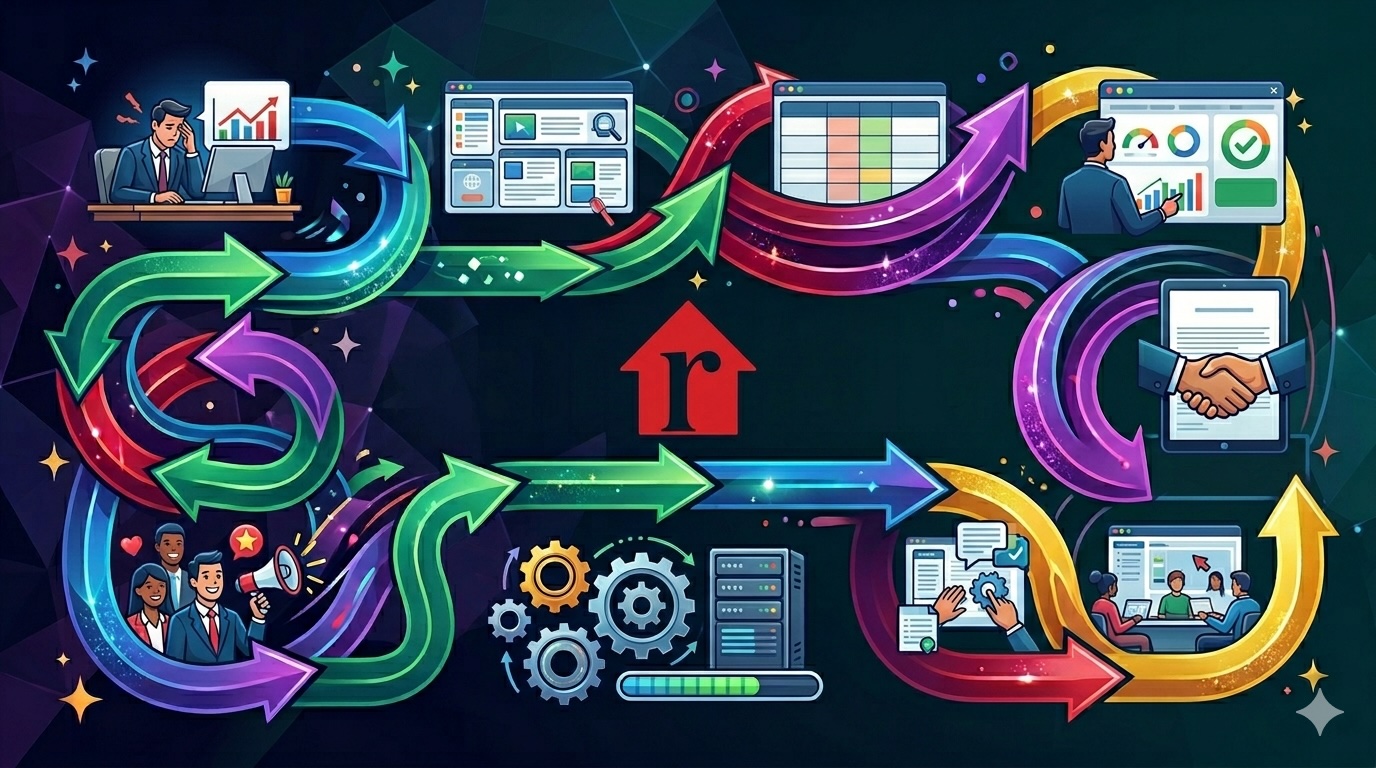
1. Stop treating the customer journey like a straight line
Traditional funnel models assume customers move predictably from awareness to consideration to conversion. In reality, customers rarely behave that way.
Blakley explained that people constantly move back and forth between stages, revisiting earlier content even when they are already deep into a purchase decision. AI-powered discovery has only accelerated this trend, allowing customers to complete significant portions of research and evaluation before ever arriving on a brand’s website.
This is the “missing middle,” the often invisible journey between first touch and conversion that many analytics systems fail to capture.
“The model I’d inherited wasn’t wrong,” Blakley said. “It just wasn’t really complete.”
For marketers, this means shifting away from rigid funnel thinking and toward a more dynamic understanding of customer journeys. The question is no longer whether content drives awareness or conversion. It’s how content helps customers move between those stages and what role each asset plays along the way.
2. Content intelligence is the connective tissue between metrics and outcomes
Before the partnership with Knotch, Realtor.com could see traffic trends, engagement metrics, and conversion results. What they could not see was how those interactions related to one another over time.
But by mapping customer journeys and visualizing content pathways, Realtor.com was able to identify which content assets assisted conversions, which created friction, and which content sequences consistently appeared in successful journeys. The team could finally see how customers moved through content rather than evaluating each page or asset in isolation.
That visibility changed how the organization thought about content performance. Rather than relying on assumptions or isolated engagement metrics, the team could identify observable behavioral patterns and optimize accordingly.
“Traffic isn’t value,” Blakley said. “A page can get a lot of visits and still be completely failing our customer.”
This learning extends to any marketing operation: Content should not be evaluated as individual assets. It should be evaluated as part of a larger system that either helps customers progress or creates obstacles along the way.
3. Replace instinct with evidence
Before Realtor.com gained visibility into customer journeys, many content decisions were being made the same way they are at most organizations: through a combination of experience, intuition, and surface-level performance metrics. That approach isn’t inherently wrong, but it often produces false positives.
Blakley explained that one of the most important shifts was moving from measuring activity to measuring contribution.
“We measure, we measure, we measure, and sometimes are left wondering why those results don’t match the effort.”
By visualizing journeys and identifying the pathways that actually led to conversion, Realtor.com was able to uncover more honest signals of customer progress. The focus shifted away from vanity metrics and toward understanding whether content was qualifying leads, reducing friction, accelerating decisions, or improving customer outcomes.
The lesson for marketers is not to abandon intuition, but to validate intuition with evidence whenever possible.
4. Different stakeholders need different stories
Organizational alignment matters – sometimes more than you think. Blakley explained that different stakeholder groups required entirely different narratives to understand and act on the findings.
Business leaders cared primarily about customer outcomes and business impact. Creative teams wanted to understand how insights should influence messaging and content development. SEO, media, and channel owners needed granular findings they could operationalize immediately. Analytics teams needed confidence in the methodology before any recommendations could gain traction.
“We all really needed to trust that underlying methodology,” Blakley said.
The Realtor.com team also focused heavily on democratizing access to data rather than concentrating insights among a small group of specialists. Teams were encouraged to explore findings, ask questions, and identify opportunities themselves. Alignment doesn’t happen through a single presentation – it requires a consistent drumbeat of communication, testing updates, shared learnings, and ongoing reporting.
5. Failed tests often produce the most valuable insights
One of the most compelling parts of the conversation centered on experimentation and organizational culture. Jordan Blakley openly acknowledged that some early tests failed, but argued that those failures ultimately accelerated Realtor.com’s progress.
“Our failures, I think, had the biggest learnings,” she said. Instead of treating unsuccessful experiments as setbacks, the team used them as diagnostic tools to better understand customer behavior and identify flawed assumptions.
Blakley also emphasized that learning itself became a meaningful success metric, particularly during periods of rapid testing and optimization.
“If we’re not failing some, we’re not testing enough,” she said.
Brown echoed this perspective, observing that failed tests often forced the team to investigate customer behavior more deeply than successful tests did.
Brands that want to take advantage of this need to create testing environments where teams feel safe sharing unsuccessful results. And they need to document and circulate these insights just as aggressively as they do with wins.
6. Separate quick wins from long-term transformation
Once Realtor.com identified opportunities for improvement, the next challenge was prioritization. Like many organizations, the team uncovered more opportunities than they could realistically execute at once. The temptation was to fix everything simultaneously; instead, they developed a roadmap that balanced immediate opportunities with larger strategic initiatives that would take longer to build and validate.
“We wanted to move very quickly on the things that would have disproportionate impact,” Blakley said. “But we didn’t want to lose sight of the longer arc changes.”
Some initiatives generated fast wins and created organizational momentum. Others required significant investment and longer time horizons. Rather than choosing between them, Realtor.com ran both tracks in parallel.
This sequencing proved critical. Quick wins built confidence, while longer-term initiatives had time to mature and demonstrate value.
For any marketer, optimization roadmaps should account not only for potential impact but also for timing, resources, organizational readiness, and implementation complexity.
7. Some of the biggest opportunities exist after conversion events
One of Realtor.com’s highest-impact optimizations came from recognizing that the customer journey effectively ended after someone submitted an inquiry form. The team had unintentionally treated lead generation as the finish line rather than a transition point into deeper education and relationship-building.
“I don’t think there was a greater cul-de-sac or cutoff terminal moment than when someone submitted an inquiry on our site,” Blakley said.
The solution was straightforward but powerful. Realtor.com continued serving educational content and relevant resources after conversion events, helping prospects become more informed before speaking with consultants and sales teams.
Many organizations accidentally create “cul-de-sac content” that stops momentum rather than sustaining it. Rather, every conversion point should be examined not as an endpoint but as the beginning of the next stage of the relationship.
In Conclusion: AI is creating an invisible funnel
AI’s growing influence on customer discovery and decision-making is any marketer’s biggest imperative today. Blakley described the emergence of what she called an “invisible funnel,” where consumers increasingly complete research, evaluation, and comparison activities through AI assistants before ever visiting a brand website.
“By the time they surface in our data, they may already have a very strong point of view about what they want and who they want it from.”
Brands ultimately need to connect visibility to measurable business outcomes. They need to build authority, create genuinely useful content, understand how customers move through increasingly fragmented journeys, and measure performance based on outcomes rather than activity.
As customer journeys become harder to see, marketers will need better connective tissue between signals, behaviors, and business results. That is the challenge (and the opportunity) that defines the modern journey to performance.
Published on June 1, 2026
Become a thought leader
Become a thought leader







Trusted by the largest (and now smartest) brands in the world.
“Before Knotch we did not understand what content was driving business results. Now we understand which content moves the needle. Knotch’s cohesive reporting and insights paint a real picture of what’s happening on our website instead of the patchwork quilt that comes from a Google Analytics approach. With Knotch we have been able to re-prioritize ad spend, route better leads to our SDR team, and inform our content development initiatives.”

"The Knotch platform ensures that we deliver high-performing content tailored to young home shoppers, enhancing their experience and driving better business outcomes.”

"Our partnership with Knotch has been highly successful, empowering us to leverage data-driven insights and refine our content strategy.”
