
AI Traffic Already Converts. What Makes It Convert More?

If a visitor comes to your site after using an AI platform, they’re more likely to be your next customer. Over the past year, Knotch Labs has shown that when visitors arrive from the likes of ChatGPT, Perplexity, and Gemini, they are nearly 4x more likely to convert than the site’s average. They take longer and more unpredictable journeys, but complete them faster.
On a macro level, it’s clear that AI traffic converts efficiently. But one question was still unanswered: What determines whether a specific page on a site captures that potential or lets it walk away? With AI citations often landing visitors in places on a site that are a long way from the homepage, this issue matters – because any page on your site could now be your “front door.”
At Knotch Labs we went deeper, analyzing AI traffic at the page level to understand what happens after the click.
What we looked at...
Recirculation rate: The percentage of visitors who, after viewing a page, navigate to another page on the same site rather than leaving.
Attributed conversion: A conversion is credited to every page that appeared in the visitor's journey to that conversion event, not just the page where the conversion happened.
Single-touch conversion: means the user only engaged with one page before converting.
Multi-touch conversion: means the user engaged with more than one page before converting.
Mid-touch: A page viewed between the first and last page in a multi-page journey to conversion. Not the entry point, not the final click.
Attribution window: June 2025 to February 2026. Conversions are tracked across multiple sessions within this period, connecting return visits to the same visitor.
We analyzed nearly 6,000 pages across 9 enterprise brands, spanning finance, technology, education, healthcare, and real estate, that received at least 10 AI-referred visits between June 2025 and February 2026. That's over 300,000 AI-driven pageviews.
What Single-Touch Data Misses
Across all the enterprise content programs that we studied, single-touch conversions were rare: 94% of all pages showed a single-touch conversion rate of zero. Pages that appeared in multi-touch journeys showed meaningfully higher attributed conversion rates. 86% of all attributed conversions occurred at mid-touch, in the middle of a multi-page journey on that site.
The Page-Level Gap
To find out which pages were driving that journey continuation, we grouped them by recirculation rate—the share of visitors who continued to at least one more page—and compared their attributed conversion rates.
Pages in the top recirculation quartile, where roughly a third of visitors continued to another page, converted at nearly 2.5x the rate of pages where visitors viewed the page and left.
The pattern held across all brands. 42% of all pages receiving AI traffic had zero involvement in any conversion. Among zero-recirculation pages specifically, that number rose to 60%, compared to just 22% among the highest-recirculating pages.
What Traditional Engagement Metrics Miss
You'd expect the pages with the best outcomes to also show deeper engagement: more scrolling, more time spent. They don't.
Pages with zero recirculation had the highest average scroll depth (47%). The pages with the highest recirculation rates came in lower (41% scroll depth). Time on page followed the same pattern: 1.6 minutes on the pages with zero recirculation, 1.3 minutes on the highest-recirculating pages.
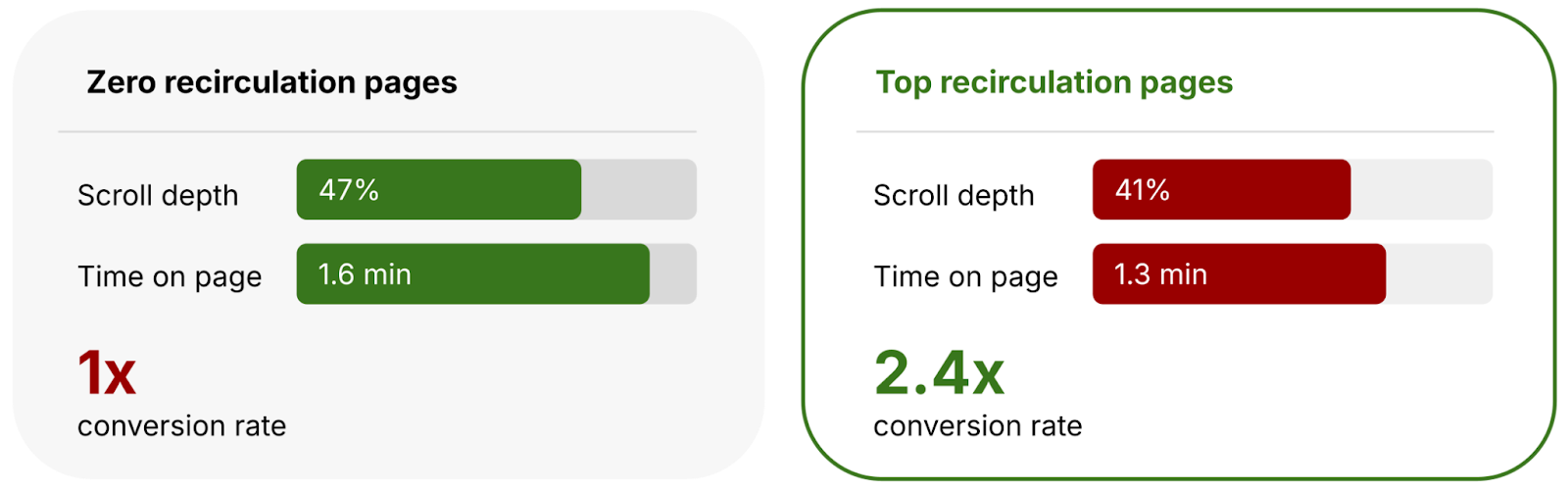
AI visitors on high-converting pages aren't reading more; they're deciding faster. They arrive with intent already formed, often shaped by an AI assistant before they ever reach the site. They don't need to consume an entire page to know what to do next. They need a clear signal for where to go.
Scroll depth tells you a visitor read the page, but recirculation tells you that they wanted more. When it comes to AI traffic, only one of those correlates with conversion.
What Marketers Should Do With This
Find the pages where AI journeys are stalling. Pull your AI-referred landing pages and sort them by recirculation rate. Blog posts, guides, and explainers are often exactly the content that LLMs cite, which is why AI visitors land on them in the first place. The goal isn’t to replace them with pages that are meant to convert in a single-touch. It’s to make sure they connect to the next step, so the journey those visitors arrived with intent to take can actually continue.
Add pathways, not just content. The pages that performed best weren't longer or more detailed, but they gave visitors a clear next step. That could mean contextual internal links, related content modules, or calls to action that guide visitors forward. AI visitors don't need to be convinced on one page; rather, they need to be guided to the next one.
Knotch clients can identify their top AI conversion pathways by filtering the Page Journeys view by AI Search referrals — seeing which pages AI visitors land on, where they go next, and which sequences lead to conversion. The Pages leaderboard filtered to AI Search referrals shows every page involved in AI journeys, whether or not they converted, making it straightforward to pinpoint where to optimize.
Measure journey contribution, not session conversion. Single-session conversion rate is the wrong metric for AI traffic. A page that generates zero in-session conversions but consistently appears as a mid-touch in converting journeys is a high-value asset, but it’s invisible in last-touch or session-only models. Multi-touch attribution that credits the full journey is the minimum requirement for understanding what AI traffic is actually doing.
Don’t use scroll depth as a quality signal for AI traffic. That’s because it doesn't predict conversion for this audience. Instead, track recirculation rate as a leading indicator for conversions.
Why This Matters Now
Most teams can tell you how much AI traffic they're getting. Very few can tell you which pages are converting that traffic and which are letting it walk away. That's the gap that actually costs you.
Today’s measurement challenge is no longer an effort to track clicks. Rather, it’s a matter of connecting those clicks to what happens next: which content keeps visitors moving, where conversion momentum builds, and where the journey breaks down. The brands that can answer those questions will get more from the AI traffic they're already earning.
Published on March 27, 2026
Become a thought leader
Become a thought leader





Trusted by the largest (and now smartest) brands in the world.
“Before Knotch we did not understand what content was driving business results. Now we understand which content moves the needle. Knotch’s cohesive reporting and insights paint a real picture of what’s happening on our website instead of the patchwork quilt that comes from a Google Analytics approach. With Knotch we have been able to re-prioritize ad spend, route better leads to our SDR team, and inform our content development initiatives.”

"The Knotch platform ensures that we deliver high-performing content tailored to young home shoppers, enhancing their experience and driving better business outcomes.”

"Our partnership with Knotch has been highly successful, empowering us to leverage data-driven insights and refine our content strategy.”
