
Your Best Content Isn't the Most Read. It's the Most Continued.

In this post:
- Why scroll depth and time on page, when measured alone, don't reliably predict conversion
- What recirculation rate is, and why it's a strong predictor of conversion
- The data: every 5-point increase in recirculation comes with a measurable conversion rate multiplier
- Where the biggest gains happen and where to focus
- How to start optimizing for content continuation
The One Metric That Actually Connects Content Engagement to Conversion
Content marketers have been wrestling with the same problem for years: connecting the metrics they have access to with the outcomes their business cares about.
When Knotch asked content leaders how their work was evaluated by their C-suites and what leadership prioritized, engagement topped the list. Growth and ROI barely came up, despite being core business-driven outcomes.
The issue isn't whether you’re tabulating engagement through page views, scroll depth or time on page. It's that none of those metrics answer the question that content teams keep getting asked: Is this content contributing to business outcomes, especially conversions?
When we compared scroll depth and time on page against conversion across 18,500+ pages from eight B2B and B2C brands, the correlations were weak and inconsistent. Scroll depth only predicted conversion in certain intent-driven channels. Time on page was counterintuitive: the longest-dwelling visitors actually converted at lower rates and were the least likely to continue to another page.
The one metric that showed a consistent relationship with conversion was recirculation rate.
What Is Recirculation Rate?
Recirculation rate measures the percentage of visitors who, after engaging with a piece of content, choose to visit another page on the same site rather than leaving. It is the inverse of exit rate, and it captures something no other single metric does: whether your content earned another click.
For content marketers under pressure to connect their work to action and prove ROI, recirculation answers the question: Is my content ecosystem functioning as a journey, or is it a collection of dead ends?
Knotch tracks recirculation rate at the page, channel, and sitewide levels, making it possible to see not just how individual assets perform in isolation, but how they contribute to the broader audience journey.
What 18,500 Pages Told Us About Recirculation and Conversion
Knotch analyzed page-level content performance data across eight B2B and B2C brands, covering more than 18,500 individual pages of content. We grouped every page by its recirculation rate in 5-point increments and compared the average conversion rate at each level.
The pattern was a consistent “staircase.” At every level, pages with higher recirculation converted at higher rates:
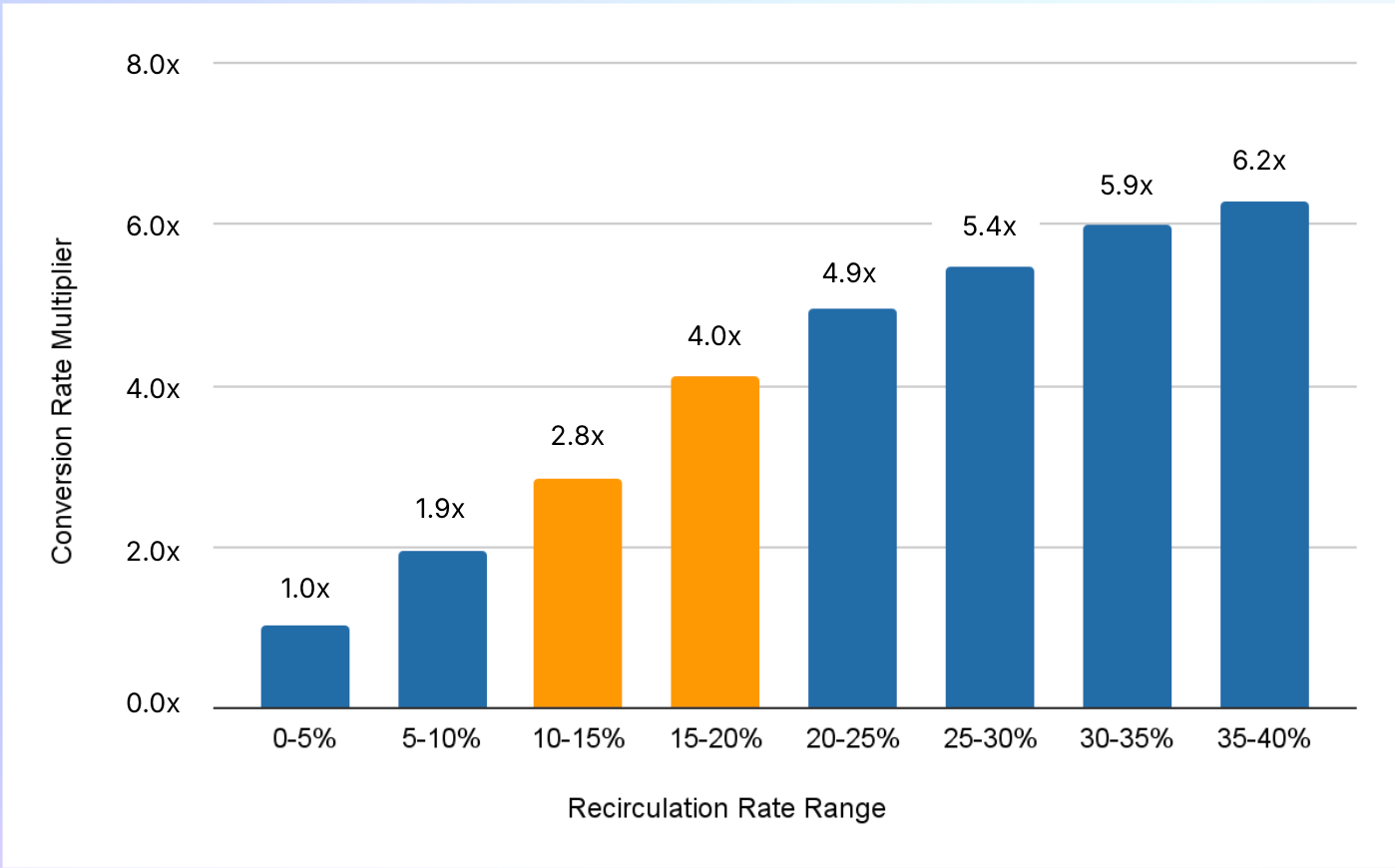
Every 5-point increase in recirculation came with a measurable increase in conversion. This wasn't a fluke in one dataset. The pattern held across individual clients. Three of the largest brands showed a clean staircase with no exceptions, and the strongest showed more than a 7x gap between the bottom and top of their pages.
Exit rate, recirculation's inverse, confirmed the finding from the other direction. It was one of the strongest negative predictors of conversion in the entire dataset. When visitors leave after visiting one page, conversions drop. When they keep clicking, conversions climb.
This is a correlation, not a causal claim. We can’t say that increasing recirculation directly causes conversions to rise. But the consistency of the pattern across eight brands and every grouping method we analyzed suggests that recirculation is one of the most reliable signals that content teams have for identifying pages that contribute to conversion.
Where the Biggest Gains Are
Not all “steps” on the staircase are equal. The largest conversion jumps happened when recirculation rates were between 10% and 20%. Moving from 10-15% to 15-20% recirculation was associated with a 1.4x increase in conversion rate, making it one of the steepest climbs on the staircase. Above 25% recirculation, conversion rate gains continued, but they began to flatten.
For content teams deciding what to focus on, this narrows the target. Look at where your pages cluster. If a large share sits below 10-15% recirculation, that's where improvements to internal linking, content pathways, and next-step CTAs will deliver the most measurable return.
Pages above 10% recirculation punched well above their weight, accounting for a disproportionate share of total conversions.
Why This Connects to the Multi-Touch Story
This builds directly on something Knotch has written about before: the outsized role that mid-touch visits play in driving conversions. In that analysis, 86% of pages had their highest number of conversions attributed to visitors who encountered them in the middle of a multi-page journey, far outpacing first touch and last touch. Mid-touch visits naturally have more opportunities to appear in longer journeys, but the concentration of conversions at this stage reinforces why keeping visitors moving matters.
Recirculation is the mechanism that creates multi-touch journeys. And the page-level data confirms why it matters. Across the dataset, multi-touch visitors converted at 34x the rate of single-touch visitors. Think of a visitor who lands on a blog post about workforce planning, clicks through to a related case study, then visits the product page. That three -page journey is far more likely to end in a conversion than a single visit to any one of those pages alone.
When readers move from one piece of content to the next, they're building familiarity, deepening trust, and self-qualifying toward a conversion. Recirculation is what makes that motion possible. It is what turns content's "Missing Middle" from a gap into a bridge.
Engagement Alone Doesn't Get You There
Another interesting finding was the relationship between recirculation and scroll depth. Pages with both high recirculation and deep scroll depth converted at 3.5x the rate of pages with low recirculation and shallow scrolling. But scroll depth alone, without recirculation, barely moved the needle.
This suggests that engagement without continuation is an incomplete metric. A visitor can scroll through an entire article and still leave without converting. But a visitor who scrolls deeply and then moves to a second page is far more likely to take action. Scroll depth tells you someone was interested. Recirculation tells you they were interested enough to keep going.
For content marketers who report on engagement metrics, this is a meaningful shift. Engagement is a necessary condition, but it’s not a sufficient one. The metric that bridges engagement to conversion is recirculation.
How to Start Optimizing for Continuation
1. Find your dead ends. Use page-level analytics to identify high-traffic pages with recirculation below 10%. These are the pieces that are getting attention but are struggling to move readers forward. Ask: is there a clear, contextual next step? Is the internal linking doing any work?
2. Focus on the 10-20% range. That's where each point of recirculation improvement delivers the biggest conversion gain. If your pages cluster below that, start optimizing with internal linking, CTAs, and content pathways.
3. Build content sequences, not just clusters. Topic clusters help with SEO. Content sequences help with conversion. Map your content against the reader's progression from curiosity to consideration to decision, and make sure you have connective material at each stage. Knotch's journey tracking shows which sequences are already forming organically so you can reinforce what's working.
4. Evaluate channels by journey quality. If conversion is the goal, a channel that drives 10,000 multi-page sessions may outperform one that drives 50,000 single-page visits. That doesn't mean single-page traffic is wasted, but it does mean the two should be evaluated differently. Knotch breaks down recirculation by referrer group, so you can see which channels are actually feeding your content ecosystem versus which ones are driving one-and-done traffic.
5. Make the case for mid-funnel content. Our data shows visitors in the middle of the audience journey make up the largest share of high-performing channels, led by direct, search organic, and email. If your editorial calendar skews toward top-of-funnel awareness content with nothing to catch visitors in the middle, recirculation will suffer and so will conversions.
The Bottom Line
Your best content isn't defined by having the most page views or the deepest scroll. It's the piece of content that earns the second page view. And the third.
For content marketers looking to connect their work to outcomes and make a stronger case for investment in content strategy, recirculation rate is the metric that bridges the gap between engagement and conversion. It's measurable, it's actionable, and across 18,500+ pages, the data is clear: when visitors keep going, conversions follow.
Published on February 27, 2026
Become a thought leader
Become a thought leader







Trusted by the largest (and now smartest) brands in the world.
“Before Knotch we did not understand what content was driving business results. Now we understand which content moves the needle. Knotch’s cohesive reporting and insights paint a real picture of what’s happening on our website instead of the patchwork quilt that comes from a Google Analytics approach. With Knotch we have been able to re-prioritize ad spend, route better leads to our SDR team, and inform our content development initiatives.”

"The Knotch platform ensures that we deliver high-performing content tailored to young home shoppers, enhancing their experience and driving better business outcomes.”

"Our partnership with Knotch has been highly successful, empowering us to leverage data-driven insights and refine our content strategy.”
